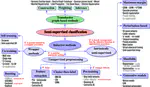
This comprehensive review analyzes 128 semi-supervised ensemble learning methods published since 2013, categorizing them by approach, ensemble type, and base classifier, and evaluating their experimental protocols, dataset usage, and statistical rigor. The study highlights the dominance of wrapper methods (especially co-training), the underuse of statistical validation, and the need for more reproducible research, while offering future directions for advancing semi-supervised ensemble learning in information fusion.
José Luis Garrido-Labrador, Ana Serrano-Mamolar, Jesús Maudes-Raedo, Juan J. Rodríguez, César García-Osorio